High Altitude Baking: How to Adjust Any Recipe
High altitude baking works when you make a few small changes to a sea level recipe: raise the oven 15 to 25°F, use less baking powder and sugar, and add a little more liquid and flour. These changes start to matter at about 3,000 feet above sea level. Thin air makes batter rise too fast, dry out sooner and sink in the middle. This guide shows each change by elevation, with grams, so you can fix cakes, cookies and bread at home.
Table of contents
Quick answer
- High altitude means 3,000 feet or more above sea level, according to USDA.
- Oven: raise the heat by 15 to 25°F and bake 5 to 8 minutes less for every 30 minutes of baking.
- Baking powder or soda: use less. At 5,000 to 6,500 feet, 1 tsp becomes 1/2 tsp.
- Sugar: use about 1 tbsp less per cup.
- Liquid: add 1 to 2 tbsp at 3,000 feet, plus 1 1/2 tsp for each extra 1,000 feet.
- Flour: add 1 tbsp at 3,500 feet, plus 1 tbsp for each extra 1,500 feet.
- Yeast bread: use about 25% less yeast and slow the rise.
- Most of these numbers come from King Arthur Baking and Colorado State University Extension.
What Counts as High Altitude?
USDA says most cookbooks treat 3,000 feet and above as high altitude. The Academy of Nutrition and Dietetics uses the same 3,000 foot line. King Arthur Baking puts the start at about 3,000 to 3,500 feet. Below 3,000 feet, Colorado State University Extension says most one bowl cake recipes need no changes. If you do not know your elevation, look up your town on a map app or ask your local cooperative extension office.
Why Thin Air Changes Your Bake
Air pressure drops as you go up, by about half a pound per square inch for every 1,000 feet, per USDA. Lower pressure lets the gas from baking powder, baking soda and yeast expand more and faster. Liquids also evaporate faster, so batter loses water and the sugar left behind becomes more concentrated. That weakens the structure of the bake. The result is often a cake that rises high and then falls, or a crumb that turns dry.
Water Boils at a Lower Temperature
Water boils at 212°F at sea level and drops by just under 1°F for every 500 feet, says USDA. This matters for anything that has to boil or simmer, like fruit pie fillings, puddings and candy. A boiling filling cannot get hotter than its boiling point, so it takes longer to thicken. The chart below uses values from Colorado State University Extension.
| Elevation | Water boils at |
|---|---|
| Sea level | 212°F (100°C) |
| 2,000 feet | 208°F (98°C) |
| 5,000 feet | 203°F (95°C) |
| 7,500 feet | 198°F (92°C) |
| 10,000 feet | 193°F (89°C) |
The 6 Basic Recipe Changes
King Arthur Baking gives six general changes that work for most cakes, cookies and quick breads. You rarely need all six at once at 3,000 feet. As you go higher, the changes get bigger. The table shows each one, with grams based on our standard cup weights.
| Change | How much | Why it helps |
|---|---|---|
| Oven temperature | Raise 15 to 25°F. Use the low end for chocolate and delicate cakes. | Sets the structure before it rises too far and dries out |
| Baking time | 5 to 8 minutes less per 30 minutes | A hotter oven finishes sooner |
| Sugar | 1 tbsp less per cup (about 12 g of white sugar) | Less concentrated sugar keeps the structure strong |
| Liquid | 1 to 2 tbsp more at 3,000 feet, plus 1 1/2 tsp per extra 1,000 feet | Replaces water lost to faster evaporation |
| Flour | 1 tbsp more at 3,500 feet, plus 1 tbsp per extra 1,500 feet (about 7.5 g per tbsp) | Adds strength to the batter |
| Baking powder or soda | Less, see the chart below | Gas expands more, so less is needed |
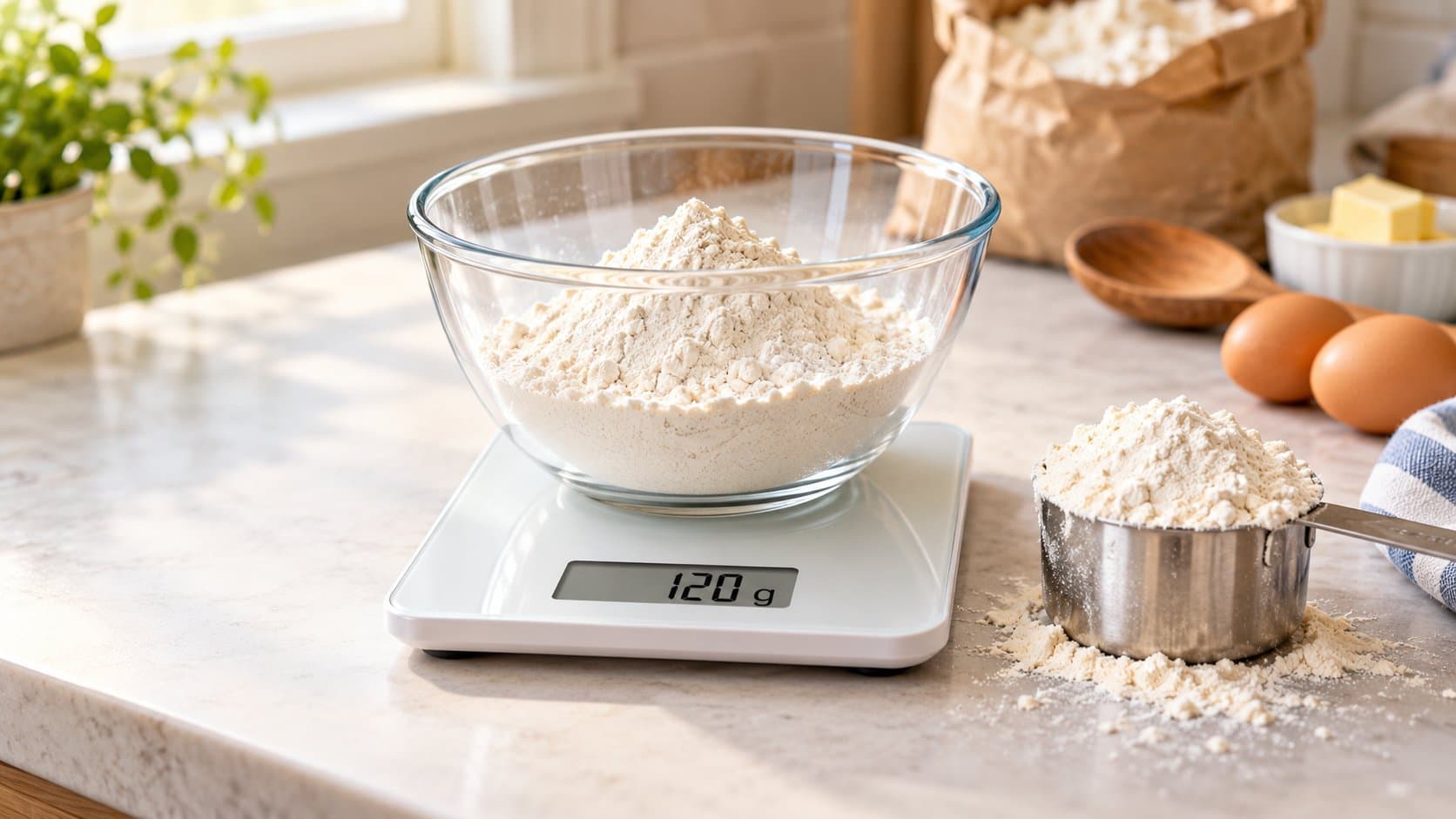
A US cup holds 16 tablespoons, so 1 tbsp less sugar per cup is a small cut of about 6%. Our tablespoons to cups converter helps when a recipe lists odd amounts. To weigh the extra flour instead, see the all-purpose flour grams to cups chart, which uses 120 grams per cup. If you bake from a recipe in Celsius, the oven temperature conversion chart gives the raised heat in °C.
How Much Baking Powder or Baking Soda to Use
Leaveners need the biggest cut, because their gas expands the most in thin air. This chart from King Arthur Baking works for both baking powder and baking soda. Find the amount in your recipe on the left, then read across to your elevation.
| Recipe amount | 3,000 to 5,000 ft | 5,000 to 6,500 ft | 6,500 to 8,000 ft |
|---|---|---|---|
| 1 tsp | 7/8 tsp | 1/2 tsp | 1/4 tsp |
| 1 1/2 tsp | 1 1/4 tsp | 3/4 tsp | 1/2 tsp |
| 2 tsp | 1 1/2 tsp | 1 tsp | 3/4 tsp |
| 2 1/2 tsp | 1 3/4 tsp | 1 1/4 tsp | 1 tsp |
| 3 tsp | 2 tsp | 1 1/4 tsp | 1 tsp |
| 4 tsp | 2 1/2 tsp | 1 1/2 tsp | 1 tsp |
Small spoon amounts are hard to measure, so a scale can help here too. Baking powder weighs about 4 grams per teaspoon and baking soda about 6 grams, as shown on our baking soda, baking powder and yeast grams page. If a recipe uses baking soda with buttermilk or sour cream, King Arthur suggests switching to all baking powder and regular milk. That swap makes the rise easier to control.
A Second Chart for Cakes by Elevation
Colorado State University Extension gives ranges for cakes instead of single numbers. Start at the low end of each range, then adjust on your next bake if the cake still sinks or dries out. The amounts are per teaspoon of baking powder and per cup of sugar or liquid in the recipe.
| Change | 3,500 to 6,500 ft | 6,500 to 8,500 ft | 8,500 to 10,000 ft |
|---|---|---|---|
| Baking powder, per tsp | 1/8 tsp less | 1/8 to 1/4 tsp less | 1/4 tsp less |
| Sugar, per cup | 0 to 1 tbsp less | 0 to 2 tbsp less | 1 to 3 tbsp less |
| Liquid, per cup | 1 to 2 tbsp more | 2 to 4 tbsp more | 3 to 4 tbsp more |
How to Adjust Cakes, Cookies, Bread and Pies
Cakes
Cakes are the most likely bake to fall at altitude, so they need the most care. Cut the sugar and leavener, and add liquid, ideally as an extra egg. King Arthur says to use egg whites if you only need part of an egg. Grease the pans well and line them with parchment, since batter sticks more up high. For rich cakes with a lot of fat, Colorado State University suggests using 1 to 2 tbsp less shortening.
Foam cakes like angel food and chiffon need one more change. Whip the egg whites only to soft peaks, not stiff peaks. The air in the whites keeps expanding in the oven, and stiff whites can overexpand and collapse.
Cookies
Cookies tend to spread more at altitude. Raise the oven by 15 to 25°F and bake 1 to 2 minutes less for every 10 minutes of baking. Chill the dough for 30 minutes to 2 hours so the fat firms up before baking. If the dough is crumbly, add a little extra water so it comes together.
Yeast Bread and Pizza Dough
Yeast dough rises much faster in thin air, which leaves less time for flavor to develop. King Arthur suggests using about 25% less yeast, so a 7 g packet (2 1/4 tsp) becomes about 5 g, or roughly 1 2/3 tsp. Use slightly colder water, and give the dough an extra rise by punching it down twice before shaping. A first rise in the refrigerator also slows the yeast and builds flavor.
Flour with more protein gives dough extra strength. Colorado State University recommends flour with at least 12% protein, such as bread flour. For bread machines, it suggests using 1/4 to 1/2 tsp less yeast per 2 1/2 tsp packet and adding 1 to 2 tbsp of extra liquid per cup of flour. Watch the dough, not the clock, so it does not over rise.
Quick Breads and Muffins
Banana bread, zucchini bread and other quick breads hold up well at altitude. King Arthur says they usually need only the six basic changes. Utah State University Extension suggests cutting the baking powder or soda in quick breads by one fourth. Check for doneness a few minutes early.
Pies
Pie crust needs no major changes because it has little moisture. Add water to the dough slowly, since too much can make it tough. Fruit pies are different, because the filling boils at a lower temperature and takes longer to set. King Arthur suggests baking them longer and adding a little more thickener, such as flour or cornstarch.
Worked Example: A Yellow Cake at 6,000 Feet
Here is how the King Arthur rules change a simple sea level cake recipe at 6,000 feet. This is a sample to show the math, not a tested recipe. Eggs, butter and salt stay the same in this example. Grams use the same cup weights as our cups to grams converter: flour 120 g, sugar 198 g and milk 244 g per cup.
| Ingredient or step | Sea level recipe | At 6,000 feet |
|---|---|---|
| All-purpose flour | 2 1/4 cups (270 g) | Add 2 tbsp (about 285 g) |
| Granulated sugar | 1 1/2 cups (297 g) | Remove 1 1/2 tbsp (about 278 g) |
| Milk | 1 cup (244 g) | Add 2 1/2 to 3 1/2 tbsp (about 282 to 297 g) |
| Baking powder | 2 1/2 tsp (10 g) | 1 1/4 tsp (5 g) |
| Oven | 350°F (177°C) | 365 to 375°F (185 to 191°C) |
| Baking time | 30 minutes | Check at 22 to 25 minutes |
The liquid math works like this: 1 to 2 tbsp for the first 3,000 feet, plus 1 1/2 tsp for each of the next 3,000 feet. That adds 4 1/2 tsp, or 1 1/2 tbsp, for a total of 2 1/2 to 3 1/2 tbsp. The flour gets 1 tbsp at 3,500 feet and 1 more at 5,000 feet. The baking powder comes straight from the 5,000 to 6,500 foot column of the chart.
Tips for Your First Bake Up High
- Make one or two changes first, such as oven heat and leavener, then add more next time if needed.
- Write down what you changed and how the bake turned out.
- Weigh flour and sugar, so small changes like 7.5 g of flour are exact.
- Check for doneness early, since a hotter oven bakes faster.
- If a recipe says it was tested at high altitude, follow it as written.
- For deep frying, lower the oil temperature by about 3°F per 1,000 feet (Colorado State University).
- For candy, lower the finish temperature about 2°F per 1,000 feet, or test your thermometer in boiling water as Utah State University describes.
Key Takeaways
Thin air above 3,000 feet makes batters rise fast, lose water and fall. A slightly hotter oven, less leavener, less sugar, more liquid and a bit more flour fix most problems. Cakes need the most changes, quick breads and pie crusts need the fewest. Yeast dough does best with less yeast and a slower, cooler rise. Good high altitude baking comes from using the charts above, starting small and adjusting after each bake.
Sources
- King Arthur Baking: High-Altitude Baking
- Colorado State University Extension: High Elevation Food Preparation Guide
- USDA Food Safety and Inspection Service: High Altitude Cooking
- Utah State University Extension: Adjusting for High Altitude Baking
- Academy of Nutrition and Dietetics: Cooking Guide for High Altitudes
- King Arthur Baking: Ingredient Weight Chart
Common questions
At what altitude do you need to adjust baking recipes?
Most sources start at 3,000 feet above sea level. USDA and the Academy of Nutrition and Dietetics both use that line. Below it, most recipes bake fine as written.
Why do cakes sink at high altitude?
Lower air pressure lets the gas from the leavener expand faster than the cake can set. The cake rises too high, then falls. Faster evaporation also concentrates the sugar, which weakens the structure.
Should you raise or lower the oven temperature at high altitude?
Raise it by 15 to 25°F, according to King Arthur Baking and Colorado State University. The extra heat sets the batter sooner. Use the smaller increase for chocolate and delicate cakes, and check for doneness early.
How much less baking powder do you use at high altitude?
It depends on your elevation. On the King Arthur chart, 1 tsp becomes 7/8 tsp at 3,000 to 5,000 feet, 1/2 tsp at 5,000 to 6,500 feet and 1/4 tsp at 6,500 to 8,000 feet. The same chart works for baking soda.
Do cookies need high altitude changes?
Yes, but the changes are small. Raise the oven 15 to 25°F, bake a minute or two less and chill the dough to limit spreading. The basic sugar, liquid and leavener changes also apply.
Does yeast bread rise faster at high altitude?
Yes. Lower air pressure makes yeast dough rise much faster. King Arthur suggests about 25% less yeast, colder water and an extra rise to build flavor.
Do box cake mixes need changes at high altitude?
Often, yes. Colorado State University suggests adding all-purpose flour and liquid to cake mixes. Check the box first, because many mixes print their own high altitude directions.