Dry vs Liquid Measuring Cups: What Is the Difference?
The difference in dry vs liquid measuring cups is how you fill them: a dry cup is filled to the rim and leveled flat, while a liquid cup has lines below the rim so you can pour and read it at eye level. Both hold the same amount, since a 1 cup measure of either kind equals 16 tablespoons. Using the wrong one still causes errors, because each cup is built for one kind of ingredient. This guide shows how to tell them apart, which cup fits each ingredient and how to use each one.
Table of contents
Quick answer
- Dry cups come in sets (1/4, 1/3, 1/2 and 1 cup). You fill them to the top and level them with a knife.
- Liquid cups are clear, have a spout and show lines below the rim. You read them at eye level.
- A 1 cup dry measure and a 1 cup liquid measure hold the same volume, 16 tablespoons.
- NIST calls using one in place of the other a common source of measuring errors.
- Use liquid cups for water, milk, oil and juice. Use dry cups for flour, sugar, brown sugar, peanut butter, yogurt and sour cream.
- Measuring spoons work for both dry and liquid ingredients.
How Dry and Liquid Measuring Cups Look Different
You can tell the two apart at a glance. Dry cups are metal or plastic and come in a nested set of sizes, says King Arthur Baking. Liquid cups are clear glass or plastic, often with a spout, and are marked in both cups and milliliters. The table sums up the main differences.
| Feature | Dry measuring cup | Liquid measuring cup |
|---|---|---|
| Material | Metal or plastic | Clear glass or plastic |
| Sizes | A set: 1/4, 1/3, 1/2 and 1 cup (some sets add 1/8, 2/3 and 3/4) | One cup with lines, often 1, 2 or 4 cups total |
| Where the amount is | At the rim | At a printed line below the rim |
| Spout | No | Usually yes |
| How to fill | Fill past the top, then sweep level | Pour to the line on a flat counter |
| How to read | Top edge of the cup | Bottom of the curved liquid surface, at eye level |
| Best for | Flour, sugar, brown sugar, thick foods | Water, milk, oil, juice |
Do Dry and Liquid Cups Hold the Same Amount?
Yes. America's Test Kitchen notes that a 1 cup liquid measure and a 1 cup dry measure both hold 16 tablespoons. In the United States, that is about 236.6 milliliters, as our cups to ml converter shows. The difference is not the size of the cup but the way you fill and read it. That is why the wrong cup can give you more or less than the recipe wants.
What Goes Wrong When You Use the Wrong Cup
Liquid in a Dry Cup
A dry cup has to be filled right to the brim, which makes liquid easy to spill on the way to the bowl. America's Test Kitchen also points out that surface tension lets water bulge slightly above the rim. That means you can pour in more than a full cup without noticing. A liquid cup leaves extra room above the line, so nothing spills.
Flour in a Liquid Cup
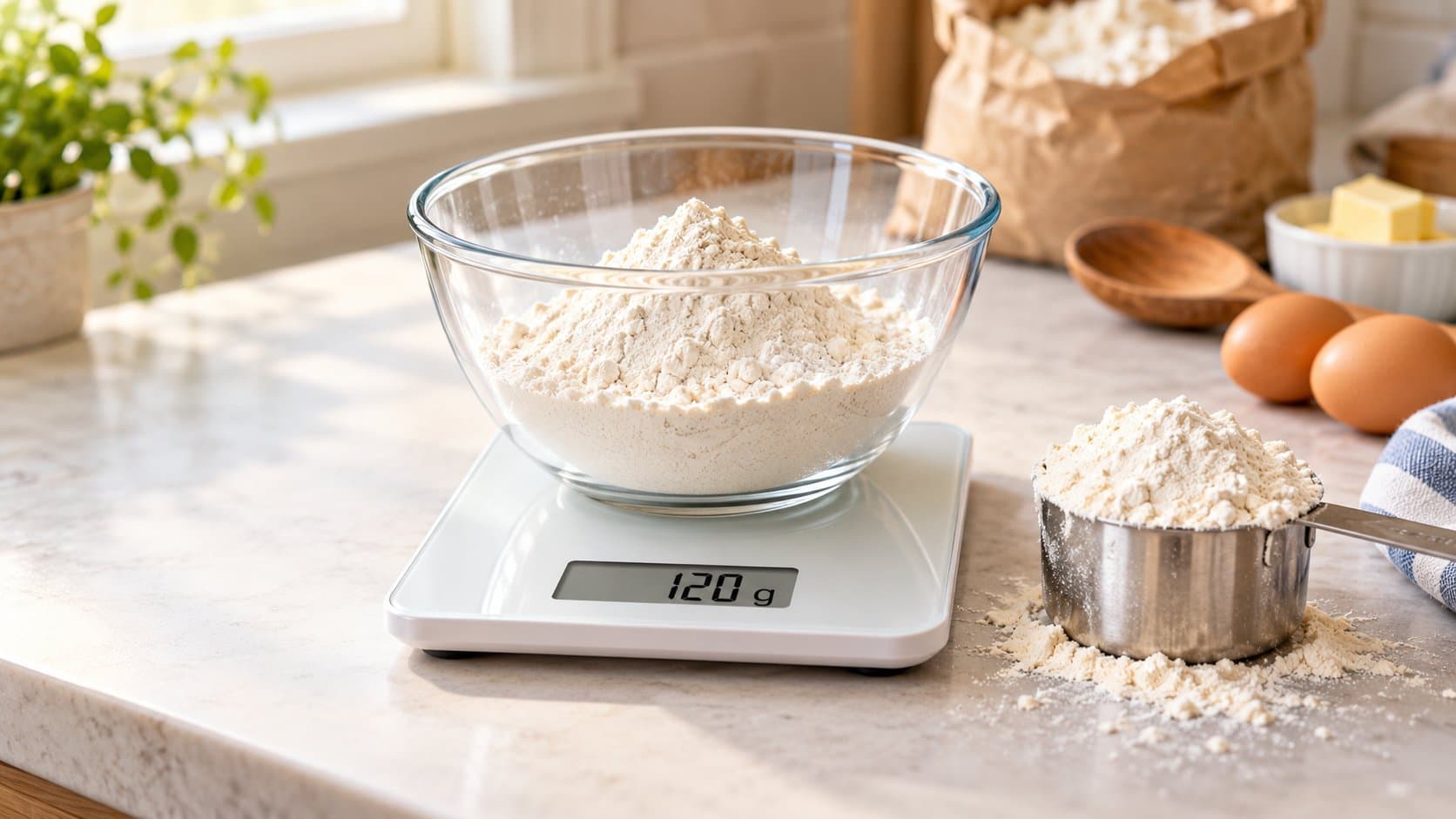
Dry ingredients do not level themselves, so they mound up in a liquid cup. The line is inside the cup, so you cannot sweep the top flat with a knife. King Arthur Baking says flour in a liquid cup cannot be fluffed, spooned and leveled the right way. A cup of all-purpose flour should weigh about 120 grams, as shown on our all-purpose flour grams to cups page, and a liquid cup makes that number hard to hit.
How to Use a Dry Measuring Cup
Pick the cup that matches the amount you need, so you do not have to guess at a half full cup. Mississippi State University Extension suggests cups with the sizes molded or engraved on them, so the labels stay readable. The steps below come from Kansas State and Mississippi State extension guides. Work over the bag or the sink to catch the extra.
- Flour and powdered sugar: stir or fluff first, spoon into the cup until it overflows, then level with the flat side of a knife. Do not pack, shake or tap the cup.
- Granulated sugar and rice: scoop or pour in until full, then level.
- Brown sugar: press it into the cup with the back of a spoon until no air pockets remain. It should hold the cup's shape when you turn it out.
- Shortening, softened butter and peanut butter: press firmly into the cup to remove air pockets, then level with a knife.
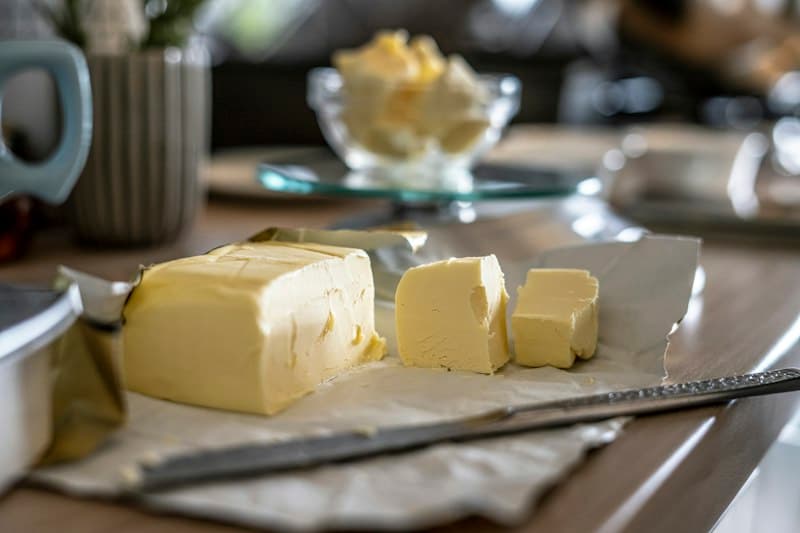
Butter often skips the cup altogether. Kansas State University notes that one 1/4 pound stick of butter equals 1/2 cup, and the wrapper is usually marked in tablespoons. Our butter grams to cups chart shows each stick and tablespoon in grams.
How to Use a Liquid Measuring Cup
A liquid cup only gives the right amount when it sits flat and you read it from the side. Holding it in the air tilts the line. These steps come from America's Test Kitchen, King Arthur Baking, NIST and Kansas State University.
- Set the cup on a flat counter. Do not hold it in your hand.
- Pour slowly until the liquid reaches the line you need.
- Bend down so your eyes are level with the line.
- Read the bottom of the curved surface of the liquid, called the meniscus.
- Use a 1 cup liquid measure for small amounts and a 2 or 4 cup measure for larger ones.
Melted butter counts as a liquid, so Kansas State measures it in a liquid cup. Syrups also go in a liquid cup, since they pour and level on their own. Use a spatula to scrape thick syrups and honey out of the cup, so the full amount reaches the bowl.
Which Cup to Use for Each Ingredient
The simple rule is this: if it pours and settles flat on its own, use a liquid cup. If it holds its shape and needs to be leveled, use a dry cup. Thick foods like yogurt and sour cream count as dry, even though they are wet. King Arthur Baking puts them in a dry cup because they do not level themselves.
| Ingredient | Which cup | Why |
|---|---|---|
| Water, milk, juice | Liquid | Pours and levels on its own |
| Oil and melted butter | Liquid | Pours and levels on its own |
| Syrup and honey | Liquid | Pours, then settles flat |
| All-purpose flour | Dry | Needs to be spooned in and leveled |
| Granulated sugar and rice | Dry | Needs to be leveled |
| Brown sugar | Dry | Needs to be packed and leveled |
| Peanut butter, shortening, softened butter | Dry | Thick, must be pressed in and leveled |
| Yogurt, sour cream, ricotta | Dry | Thick, does not level itself |
| Salt, baking soda, spices, extracts | Measuring spoons | Amounts under 1/4 cup |
What About Measuring Spoons?
Measuring spoons do double duty. Kansas State University says one standard set of 1/4, 1/2 and 1 teaspoon plus 1 tablespoon works for both dry and liquid ingredients. Use them for amounts under 1/4 cup, like salt, baking soda, spices and flavorings. Level dry ingredients flat, and fill liquids to the top without spilling over.
A cup holds 16 tablespoons, so spoons and cups connect with simple math. Our tablespoons to cups converter does the math when a recipe gives an odd number of spoons. That helps when you need 1/8 cup and your set does not include that size.
Fluid Ounces Are Not the Same as Ounces
Liquid cups are often marked in fluid ounces, which can cause mix ups. NIST explains that US customary units have separate measures for liquid volume and weight, such as the fluid ounce and the regular ounce. A fluid ounce measures space in a cup, while an ounce on a scale measures weight. So 8 ounces of flour by weight is not the same as the 8 fluid ounce line on a liquid cup. Our grams to ounces converter explains weight ounces in more detail.
Tips for Accurate Measuring With Cups
- Keep one set of dry cups and one liquid cup just for baking.
- Check that your cups are accurate. King Arthur notes that some low cost cups may not be.
- Never measure over the mixing bowl, so spills do not end up in the batter.
- Measure dry ingredients before wet ones, so the same cup stays clean and dry.
- For the most accurate result, NIST and America's Test Kitchen both suggest weighing ingredients on a kitchen scale.
Cups work well for everyday baking when you use the right one. A scale removes the guesswork for flour and other ingredients that pack down. Read our guide on why baking by weight is better to see the difference it makes.
Key Takeaways
Dry and liquid measuring cups hold the same volume, but each is built for a different kind of ingredient. Dry cups are filled to the rim and leveled, and liquid cups are read at a line, at eye level, on a flat counter. Pourable foods go in a liquid cup, while flour, sugar and thick foods go in a dry cup. Spoons cover small amounts of both. Picking the right cup is a small habit that keeps your bakes consistent.
Sources
- King Arthur Baking: When to use dry vs. liquid measuring cups, and why it matters (Kelly Vaughan, 2025)
- America's Test Kitchen: Do You Really Have to Use Different Measuring Cups for Liquid and Dry Ingredients? (2022)
- NIST: Metric Kitchen, Culinary Measurement Tips
- Kansas State University Research and Extension: Cooking Basics, Measuring Tools and How to Use Them (MF3518)
- Mississippi State University Extension: Measuring Dry or Solid Ingredients
Common questions
Can I use a liquid measuring cup for dry ingredients?
It is not a good idea. Dry ingredients mound up in a liquid cup, and you cannot level them with a knife because the line is inside the cup. Your flour or sugar will likely be off.
Can I use a dry measuring cup for liquids?
You can in a pinch, but it is easy to spill or overfill. Surface tension lets liquid rise slightly above the rim of a dry cup. A liquid cup with room above the line is more accurate.
Is 1 cup dry the same as 1 cup liquid?
Yes, by volume. Both a 1 cup dry measure and a 1 cup liquid measure hold 16 tablespoons, about 236.6 milliliters in the US. The weight inside each cup depends on the ingredient.
Is yogurt measured as a dry or liquid ingredient?
Use a dry cup. King Arthur Baking groups yogurt, sour cream, peanut butter and ricotta with dry ingredients because they do not level themselves. Spoon them in and smooth the top flat.
How do you read a liquid measuring cup correctly?
Set the cup on a flat counter and bend down so your eyes are level with the line. Read the bottom of the curved surface of the liquid. Do not hold the cup up in the air.
Why do measuring spoons work for both dry and liquid ingredients?
Spoons are small enough that you can fill them to the edge with liquid or level them with dry ingredients. Kansas State University says one standard set covers both. Use them for amounts under 1/4 cup.